

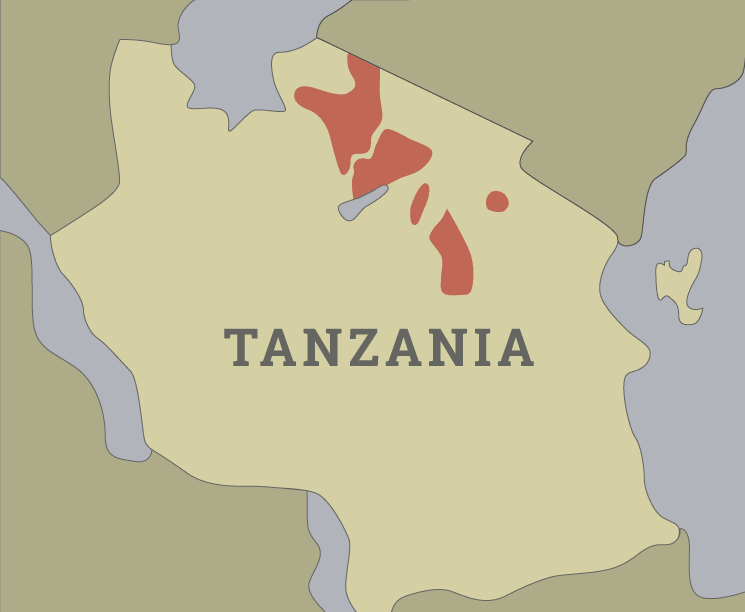
Weather
Occasional showers can be expected in November. In late November, towering
thunderclouds form and herald the onset of the green season. November
is a period of dramatic change as the rains transform the parched landscape.
The rains from early November to late March are usually sporadic and
typically do not last for more then a few hours. There is a chance of
heavier rain during this period but during most years the heavier rains
fall in April. These expected sporadic showers do not usually pose much
of an inconvenience while game driving. If it does rain, it will usually
clear in 1-2 hours and more then likely the rain will be localized.
It is rare that rain clouds will settle over a large area for an extended
period of time.
Rain falls in different amounts over various locations throughout Northern
Tanzania. The Ngorongoro Crater, Tarangire and Lake Manyara receive
higher rainfall then many parts of the Serengeti. There is a steep rainfall
gradient in the Serengeti from the dry southeast to the wet northwest.
The winds that bring rain blow from the east. The Ngorongoro Highlands
block much of the rain from reaching the eastern and southern plains
of the Serengeti. However, the western and northern parts of the Serengeti
receive a much greater amount (2-3 times more) of participation as compared
to the southern and eastern Serengeti. The wetter western and northern
Serengeti areas are affected by Lake Victoria.
Temperatures are pleasant with an average high of 83 degrees and an
average low of 60 degrees. However, the rim of the Ngorongoro Crater
can get quite cold at night and in the early morning. Visitor numbers
are relatively low during November, which combined with good game viewing
opportunities makes this month an excellent choice for a safari.
Seasonal Wildlife Highlights
Serengeti National Park
Northern Serengeti (Woodlands)
November Recommended Duration of Game Drives: 1 - 2 Days (Early
to Mid November Only)
November Wildlife Highlights: Wildebeest Migration, Zebra Migration,
Lion, Hyena, Elephant, Giraffe, Impala, Buffalo, Hippo
As the plains dried out sometime in May or early June, the wildebeest
and zebra migration moved north and west off the plains into the woodlands.
As the dry season progressed, the great herds continued to shift northward
towards the Northern Serengeti and the Masai Mara in Kenya. From early
August to early October, the main wildebeest and zebra herds were located
in their dry season refuge in the Masai Mara and the Northern Serengeti.
During October, the southward migration is expected to begin. At the
first scent of rains, the great herds will come thundering down the
northern corridor and flood out onto the southern and eastern plains
of the Serengeti. The exact timing of this mass movement is entirely
dependent upon the beginning of the rains. However, usually sporadic
showers begin in the northern woodlands around mid October thus triggering
the main herds south. Typically, the main migratory herds will be passing
through the Northern Serengeti from about mid October to mid November.
The migration moves quickly at the onset of the rains through the northern
woodlands and the herds follow both the rainfall and forage gradient
south onto the plains. Kleins Camp, Migration Camp or the northern campsites
are in prime positions to catch the migratory action from about mid
October to Mid November.
During November, the southward wildebeest and zebra migration will be
in full swing. The migration movements are notoriously unpredictable
and are anything but a coordinated movement. Careful planning is required
in November to provide the best chance of witnessing this extraordinary
wildlife spectacle.
If you will be arriving in the Serengeti from early to mid November,
the Northern Serengeti and Central Serengeti will provide the best bases
to catch the migration. The migration will likely be in both these areas
during this period (the frontrunners in the Central Serengeti and the
tail end of the migration in the Northern Serengeti).
If you will be arriving in the Serengeti from mid to late November,
the Western Serengeti and Central Serengeti will provide the best bases
to catch the migration. By mid November, the migration will likely have
made its way past the lodges and camps in the Northern Serengeti and
should be located around the central region of the Serengeti or be moving
south along the eastern boundaries of the park. In this case, the herds
can be reached with game drives in the Central Serengeti and game drives
out east towards the Barafu Kopjes along the eastern border of the park.
A significant portion of the wildebeest migration also gathers in the
Western Serengeti during November before making their final movement
to the southern plains. This is especially true if the rains have been
light. In this second case, the Western Serengeti will provide access
to a portion of the migration.
The northern region of the Serengeti is a vast pristine area of wooded
rolling hills interspersed with open grassy patches and large granite
outcrops. This region extends north about 55 miles from Seronera in
the Central Serengeti to the Masai Mara Game Reserve in Kenya. Most
visitors to the Serengeti never see the northern region. It is only
rarely visited and remains an unexplored and untouched wilderness packed
with stunning landscapes and large concentrations of wildlife during
the dry season.
The Northern Serengeti supports a good number of resident herbivores
including giraffe, hippo, topi, impala and Thomson’s gazelle.
This area is home to the largest remaining concentrations of elephants
and buffalo in the Serengeti. All four large carnivores (lion, leopard,
cheetah and hyena) are also resident in the Northern Serengeti.
Western Serengeti (Woodlands)
November Recommended Duration of Game Drives: 0 - 1 Day (Mid to
Late November Only)
November Wildlife Highlights: Lion, Giraffe, Impala, Hippo, Resident
Wildebeest and Zebra, and Possibility of the Wildebeest Migration
The Western Serengeti is home to significant numbers of resident wildlife.
There are large populations of resident wildebeest and zebra that do
not join their migratory cousins as they pass through every year on
their journey northwards. Other resident animals include giraffe, buffalo,
eland, topi, impala, waterbuck and Thomson’s gazelle. These resident
animals support good concentrations of predators including lion, leopard,
cheetah and hyena. The big cats are frequently sighted but not to the
extent as seen in the Central Serengeti. The Western Serengeti is at
its best from late May to Mid July.
By mid November, the migration will likely have made its way past the
lodges and camps in the Northern Serengeti and should be located around
the central region of the Serengeti or be moving south along the eastern
boundaries of the park. However, a significant portion of the wildebeest
migration also gathers in the Western Serengeti during November before
making their final movement to the southern plains. This is especially
true if the rains have been light. In this case, the Western Serengeti
will provide access to a portion of the migration. Accordingly, we recommend
spending a night in the Western Serengeti from mid to late November.
In early November, a good option on longer safari itineraries is to
incorporate a day drive into the western corridor while staying in the
Central Serengeti. This will enable you to quickly see the West while
still focusing on the better game viewing areas in the Central and Northern
Serengeti.
Central Serengeti (Plains/Woodlands Border)
November Recommended Duration of Game Drives: 2 - 3 Days
November Wildlife Highlights: Leopard, Lion, Giraffe, Impala, Buffalo,
Hippo, Wildebeest Migration, Zebra Migration
The Central Serengeti is the prime area to focus your safari in November.
During typical years, the herds pour through the Central Serengeti during
the month of November. The migration should be located around the central
region or be moving south along the eastern boundaries of the park.
The herds can usually be reached with game drives in the Central Serengeti
and game drives out east towards the Barafu Kopjes along the eastern
border of the park.
The Central Serengeti offers superb game viewing year round due to the
abundance of resident animals. Specifically, the Seronera River Valley
in the Central Serengeti is a ‘must see’ on every safari
regardless of the specific month of travel. Game viewing is better during
the dry season (June - early November) but during the wet season (including
most of November) there is still plenty of resident animal action. Resident
herbivores include impala, buffalo, hippo, warthog, topi, hartebeest
and giraffe. Resident carnivores include lion and leopard.
There are 12 documented resident lion prides just within a one-hour
game drive radius from Seronera. All these prides do shift east and
south in their territories during the wet season (beginning in November)
but they are still reachable though not in the same numbers found during
the drier months. November is one of the favorite times of year for
the resident Seronera lion prides as they usually have access to the
moveable feast during this time.
The Seronera Valley in the Central Serengeti is also one of the best
areas in Africa to spot the elusive leopard. You will likely encounter
this majestic cat in the branches of the sausage trees that dot the
banks of the Seronera River.
Eastern Serengeti (Plains)
November Recommended Duration of Game Drives: 1 Day
November Wildlife Highlights: Cheetah, Hyena, Eland Migration, Thomson’s
Gazelle Migration
The Eastern Plains of the Serengeti are extremely seasonal. During the
dry season, you will likely encounter only a few hearty Grant’s
gazelle. However, the eastern plains come to life in the wet season
including November and offer incredible game viewing for certain species
of animals. A day trip at the minimum should be included in every green
season itinerary.
The GOL Kopjes, located on the Eastern Plains, boasts the highest concentrations
of cheetahs in Africa during the wet season. The majority of the cheetahs
in the Serengeti are migratory in that many of them follow the Thomson’s
Gazelle migration to the eastern short grass plains during the wet season
and then back to the Central Serengeti (plains/woodland border) during
the dry season.
The Eastern Plains are also the main wet season range of the giant eland
migration. Additionally, you will likely find large clans of hyenas
numbering up to 30 individuals in a single group. Hyenas are semi-nomadic
and ‘commute’ to the Eastern Plains during the wet season
from their den sites located in the Central Serengeti.
November is the beginning of the wet season and game viewing is somewhat
unpredictable on the eastern plains and is entirely dependent upon the
onset of the rains. If the rains have been normal, then game viewing
will be good. If the rains have been late, the eastern plains will most
likely not offer great game viewing until December. Regardless, a day
trip to the Gol Kopjes on the eastern plains is warranted in November.
Southern Serengeti (Plains)
November Recommended Duration of Game Drives: 1- 2 Days
November Highlights: Walking Safaris, Cultural Interactions and possibility
of fair to good game viewing depending upon the onset of the rains
It is the life giving rains that generally begin in mid to late October
that triggers the great migration to head to the southern plains from
their dry season refuge in the northern woodlands. The rains tend to
begin later in the south as opposed to the north. Typically, the rains
do not begin in the southern plains until early November.
The plains are reborn with the first drops of rain in November. They
are instantly transformed from a brown, parched semi desert to an intense
green as new grasses sprout in a matter of days. The great herds and
the many other animals that have been forced to the woodlands for foraging
and water come flooding back onto the plains.
Wildlife viewing is in a state of flux on the Southern Plains during
November and is entirely dependent upon the onset of the rains. If the
rains have been normal, then game viewing will be fair to good. If the
rains have been late, the southern plains will likely not offer their
world renowned game viewing until December.
The Southern Plains of the Serengeti are extremely seasonal. During
the dry season, you will likely encounter only a few hearty Grant’s
gazelle and the occasional giraffe. However, the southern plains come
to life in the wet season (late November - mid June) and offer unparalleled
game viewing.
During the dry season when the migratory animals have moved off the
southern plains and into the woodlands, we recommend a one-night stopover
(as time permits) on your way from the Central Serengeti to the Ngorongoro
Crater. A night in the southern plains will provide for excellent walking
and hiking options, cultural interactions with the Maasai and a chance
to explore this beautiful part of the Serengeti ecosystem. The southern
plains of the ecosystem in the Ngorongoro Conservation Area (NCA) offer
the best walking safari options and cultural opportunities. Olduvai
Camp, located on the southern plains of the NCA, is the ideal place
to spend a night if you are interested in the aforementioned activities.
During the wet season, the southern plains offer some of the best game
viewing in Africa. The green season is a wonderful time to be on safari
in the southern Serengeti and the northern Ngorongoro Conservation Area.
Rain means game in the Serengeti and wildlife should be prolific on
the Southern Serengeti Plains starting in late November. More Serengeti
National Park Information.
Ngorongoro Crater
November Recommended Duration of Game Drives: 1 - 2 Days
November Wildlife Highlights: Black Rhino, Elephant, Buffalo, Lion,
Cheetah
The Ngorongoro Crater, described as one of the wonders of the world,
is an amazing natural sanctuary not to be missed. Game viewing here
is among the very best Africa has to offer and is excellent at any time
of year. The crater is very small at only about 10 miles across. With
just one game drive in the Crater, it is possible to circumnavigate
the crater several times and see all the main highlights. However, every
safari we offer includes two separate game drives in the Crater over
a course of two days including one early morning 6AM drive. The goal
on the early morning game drive is to be the first person in the Crater
that day. Animals are generally more active in the morning, which makes
the early morning game drive option an excellent choice.
The crater is not a self-contained ecosystem and some animals do migrate
in and out of the surrounding NCA but not in any significant numbers
to warrant tailoring your itinerary. The main factors for planning are
weather and visitor numbers. The weather will be pleasant in November
and visitor numbers will be relatively low. More Ngorongoro
Crater Information.
Tarangire National Park
November Recommended Duration of Game Drives: 2 Days
November Wildlife Highlights: Elephant, Lion, Giraffe, Impala, Raptors
At 1,600 square miles, Tarangire National Park is much smaller and lesser
known than its famous neighbors to the north. However, during the dry
season wildlife concentrations rival that of the Serengeti. The wildlife
rhythms of Tarangire are almost directly opposite to those of the Serengeti.
Tarangire comes into its own during the dry season (July - November)
when enormous populations of elephants and other animals are drawn to
the Tarangire River and other sources of permanent water within the
park. During the wet season, many of the animals disperse into the surrounding
areas of the greater ecosystem.
During June and July, the surrounding areas began to dry out and many
of the animals began to migrate back into Tarangire from the greater
ecosystem. During August, September and October, the outlying areas
were completely parched. Massive herds of buffalo, wildebeest, zebra
and elephant congregated around the remaining rivers and swamps inside
Tarangire.
Sporadic showers are expected in Tarangire in late October. These showers
and the continued light rains in November disperse the large herds of
zebra and wildebeest into the surrounding ecosystem. It takes a few
heavier rains in either November or December to disperse the larger
elephant herds. Game viewing is still excellent in November for elephant
but the herds of zebra and wildebeest will quickly migrate out of the
park.
Wildlife viewing will be good to excellent in November depending upon
the onset of the rains. The great news is that elephant viewing will
still be outstanding in November and it is likely that you will see
over 200 of them on a single game drive. This combined with the spectacular
scenery will surely make for a memorable visit. Expect to also see giraffe,
buffalo and several species of antelope. With a little luck you will
also encounter a leopard and some of the rarer antelopes including elands,
kudus and oryx. Lions are still resident within the park but they are
generally more difficult to find. Tarangire is a must see on every safari
from mid July to late November. More Tarangire
Information.
Lake Manyara National Park
November Recommended Duration of Game Drives: 0 - 1 Day
November Wildlife Highlights: Elephant, Baboons, Giraffe, Impala, Birding
Game viewing is generally fair to good in Lake Manyara at any time of
year. However, Lake Manyara does not offer the abundance of wildlife
nor quality of wildlife viewing experiences found in the other parks
of Northern Tanzania. Similar to Ngorongoro Crater, seasonal wildlife
patterns are not significant enough to warrant tailoring your itinerary.
Lake Manyara is a beautiful little park and is famous for its tree-climbing
lions, elephants and large troops of baboons. The park is home to an
amazing variety of birds and animals considering its small size. A short
visit to this serene park will greatly diversify your safari experience
as the lush green jungle habitat is of stark contrast to the other parks
you will visit during your safari.
We find that a quick day visit to Lake Manyara before either heading
back towards Kilimanjaro or on the way from the Crater to Tarangire
is sufficient and ideal for most travelers. The park gate is just a
few feet from the main road and this combined with the fact that the
park is small allows for quick and rewarding forays into the park. A
one to four hour visit to Lake Manyara makes a superb addition to any
safari itinerary. More Lake
Manyara Information.
Select another month:
JANUARY
MAY
SEPTEMBER
FEBRUARY
JUNE
OCTOBER
MARCH
JULY
NOVEMBER
APRIL
AUGUST
DECEMBER